
rediffGURUS Mihir Tanna, Vipul Bhavsar, T S Khurana, Vivek Lala and Anil Rego will answer your tax queries related to the Union Budget 2026-2o27.

Budget 2026 sticks to fiscal discipline, shuns populist measures despite five key state elections coming up, but ends up rattling stock markets with a higher transaction tax on derivatives trading.
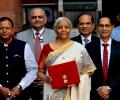
The Budget session of Parliament will be held from January 28 to April 2, featuring the President's address, the Economic Survey, and the presentation of the general Budget.

Finance Minister Nirmala Sitharaman announced a fiscal deficit target of 4.3% of GDP for FY27, continuing the path of fiscal consolidation. The government aims to reduce the debt-to-GDP ratio to 55.6% by BE 2026-27 and further to around 50% by March 2031.

Both Houses of Parliament were adjourned sine die, concluding a Budget session marked by the passage of key legislations and the defeat of a Constitution amendment bill on women's reservation. The session saw frequent opposition protests and discussions on various issues, including the West Asia conflict.

The conflict may disrupt Budget 2026-2027 projections, squeezing revenues and raising subsidies, prompting fiscal adjustments and potential reforms, echoing lessons from the Covid-era shock, points out A K Bhattacharya.

Finance Minister Nirmala Sitharaman will present her 8th straight Budget and all eyes will be on the much-expected tax relief for the middle class. Sitharaman had in her first Budget in 2019 replaced the leather briefcase -- which had been in use for decades for carrying Budget documents -- with a traditional 'bahi-khata' wrapped in red cloth.

The first leg of the Budget session concluded with debates over the India-US trade deal and a former army chief's memoir, and will reassemble on March 9.

The Congress party has strongly criticized the Union Budget, calling it 'lacklustre' and 'disappointing,' claiming it fails to address the needs of farmers, unemployed youth, and other key sectors.

With the Union Budget 2026, India's 74th, fast approaching, all eyes are once again on New Delhi's North Block as Finance Minister Nirmala Sitharaman is preparing to table it on February 1, 2026, marking her ninth Budget presentation in a row.

Finance Minister Nirmala Sitharaman on February 1 will present a record eighth consecutive budget that is expected to contain measures to shore up weakening economic growth and ease the burden on the middle class struggling with high prices and stagnant wage growth while being fiscally prudent.
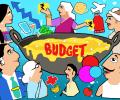
Finance Minister Nirmala Sitharaman on Tuesday presented the Budget for 2024-25, her 7th straight presentation surpassing the record of former prime minister Morarji Desai. This is the first Budget during Prime Minister Narendra Modi-led government's third term in office.

This year's Economic Survey and the Union Budget were more closely followed for more reasons than one.

The government on Sunday gave a strong push to upgradation and expansion of healthcare infrastructure, medical education and pharma sector with the Union Budget 2026-27 announcing a slew of steps, including those aimed at making India a global hub for allied healthcare professionals and biopharma manufacturing.

Sitharaman took charge of the Finance Ministry on May 31, 2019, and has steered the economy through the COVID-19 pandemic and geopolitical turmoil, making India the fastest-growing major economy in the world.

Sitharaman continues with the tradition she set in 2019, carrying the budget speech in a 'bahi-khata', which she used after dropping the briefcase tradition.

These are the highlights of the Union Budget 2025-26 presented by Finance Minister Nirmala Sitharaman in Parliament on Saturday.

No income tax relief, but compliance burden eased for youth and middle class through lower TCS.

'If you go by the capital expenditure, this is a good defence budget. But we will have to see if the government can keep defence spending at 2 per cent or higher in 2027-2028.'

Finance Minister Nirmala Sitharaman on Sunday makes history as she presents a record ninth consecutive Budget that is expected to unveil measures to sustain growth momentum, maintain fiscal discipline, and contain reforms that could buffer the economy from global trade frictions, including US tariffs.

India Inc on Sunday hailed the Union Budget 2026-27 as a 'structural shift' in the country's technology landscape, noting that the government is moving beyond fragmented pilots to build foundational layers where AI serves as a 'horizontal enabler' for the entire economy.

This is the first Budget in my memory of Budgets over the last half a century which has embraced upfront, enthusiastically and emphatically, technology, modernity and fiscal sobriety, notes Shreekant Sambrani.

Officials said the government is keen to conform to the convention of the Union Budget for 2026-2027 being presented on February 1 despite it falling on a Sunday in 2026.

The Budget emerges as a measured, credible and forward-looking policy document that reinforces India's commitment to remaining a stable, reform-oriented economy amid an increasingly fragmented global landscape, says A Balasubramanian.

India is a global leader in software development services, IT enabled services, knowledge process outsourcing services and contract R&D services relating to software development, Sitharaman said noting these business segments are quite inter-connected with each other.

'In all these years of rupee depreciation, of rising oil prices, of inflation caused by import dependence, not one leader had the courage to look the people in the eye and say: Please do this for your country.'

Nirmala Sitharaman moved into her Kartavya Bhavan office on October 2, in time to get the work on the Budget 2026-2027 going.

Here are the key numbers to watch out for in the Union Budget for 2025-26:
The 2026-27 Budget, seeking to harmonise the government's imperative to grant certainty while ensuring a rational tax policy, had several notable announcements to usher in halcyon days, says Mukesh Butani.

India's fertiliser subsidy bill for the current financial year (FY27) is projected to increase by approximately 20% due to surging global prices, primarily driven by the West Asia crisis, a senior official confirmed. Despite this, retail prices for urea and di-ammonium phosphate (DAP) will remain unchanged, ensuring adequate supply for the kharif season.

The forthcoming Budget could think of maintaining public capital expenditure at 3 per cent so that domestic resources are available for private investments, points out N R Bhanumurthy.
CA Sumeet Mehta analyses the Union Budget 2026-2027, identifying key positives and negatives.

Even if there is an early agreement on a cessation of hostilities in West Asia, the price shock will not go away easily, points out A K Bhattacharya.

After the last Budget's announcement of a major tax relief for those earning an annual salary of less than Rs 12 lakh, there is not much that individuals can look forward to in the forthcoming Budget, points out A K Bhattacharya.
The Union Budget backs skilling across animation, gaming and comics. But creators and studios confront a hard question: who owns what comes next?

The 4th India Sporting Goods Fair (ISGF) is set to take place, showcasing athletic gear and equipment from across the country, as the government pushes to establish India as a global hub for sports goods manufacturing.
This Budget positions India's taxation ideology as not merely a revenue source but as a strategic catalyst for growth, inclusion and long-term confidence.
The 4th India Sporting Goods Fair (ISGF) showcases athletic gear and equipment from 75 exhibitors, highlighting the government's commitment to promoting sports goods manufacturing in India.

The idea of back-loading the target of fiscal consolidation is perhaps guided by the government's desire to be prepared for any adverse developments in the coming year, points out A K Bhattacharya.
 © 2026 Rediff.com - Advertise with us - Disclaimer - Privacy Policy - Sitemap - Feedback - About us - Terms of use - Grievances